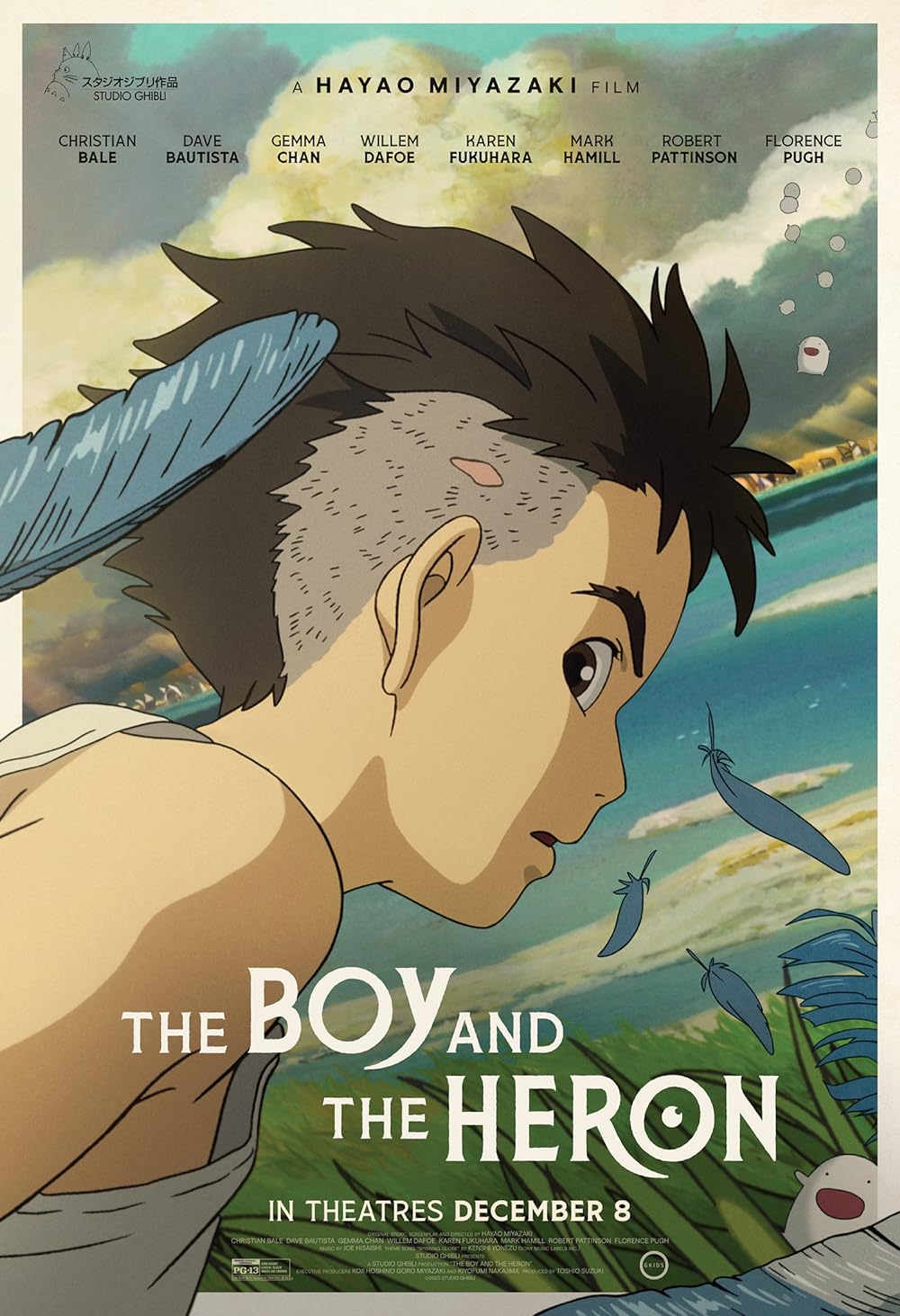
The Boy and the Heron, the one-time final film of animation prodigy Hayao Miyazaki, is a beautifully heart-wrenching tale unlike any Ghibli film before it. Much of Miyazaki’s filmography focuses on his experience as a father, portraying characters and imparting messages as he would want his children to experience them. Yet, taking a step farther than the realism of war shown in The Wind Rises, The Boy and the Heron paints a vivid and almost painful picture of Miyazaki’s own life, to the point that within the first few minutes I was on the verge of tears. The Boy and the Heron is a masterpiece, but more than that, it is the synthesis and culmination of Miyazaki’s entire body of work, and a commentary on his own life – one that he would do well to learn from.
Heron is, as described by its creators, a semi-autobiographical fantasy, and its opening scene will quickly remind you of that fact. The film begins with the bombing of Tokyo. Mahito, learning that the hospital his mother is in has caught fire, races through streets filled with the ghostly shapes of the living, shrouded in smoke and ash, only to get there too late. A year later, Mahito and his father Shoichi move to the countryside childhood home of his late mother, where Shoichi remarries to Mahito’s aunt. The tension implicit in this relationship drives Mahito to self-isolation and self-harm. In due course, he meets the Heron, a mysterious figure who pulls him into a fantastical world where the living and the dead both reside. Mahito journeys through this world, guided by the untrustworthy Heron, to meet the world’s creator, the Granduncle, and discover his own purpose.
Paramount to devoted Ghibli viewers is the art, and in this department The Boy and the Heron delivers. As with content and theme, Heron is a celebration of all that has come before it in Miyazaki’s impressive filmography. It blends the surreal of Spirited Away, the bombastic whimsy of Porco Rosso, the naturalistic reverence of Princess Mononoke, and the heartfelt realism of The Wind Rises all into a single tight two-hour package that both encapsulates and builds on each of these elements. Joe Hisaishi’s composition, as always, evokes emotions most features could not hope to muster, loud and impactful when it counts, only to fade to a silence that leaves the viewer in a breath-hold that feels like it might never end. It’s these moments of quiet, of total silence, that beg the viewer to sit with the scene, and to feel what the characters feel. The Boy and the Heron, through its art, soundscape, script and pacing, will take the viewer on undoubtedly the most intense rollercoaster Miyazaki has crafted in his career. It’s not a funny movie, but the at times charming, at others outright goofy visuals successfully reset even the heaviest scenes.
Most important for this film, however, is its context. The Boy and the Heron is a film about life and death, about history and legacy, and it invites us to consider the legacy Miyazaki will leave behind when he – eventually – does stop making films. In an excerpt from the project proposal for the film, Miyazaki wrote:
“There’s nothing more pathetic than telling the world you’ll retire because of your age, then making yet another comeback. Is it truly possible to accept how pathetic that is, and do it anyway?”
I vehemently disagree. When he said The Wind Rises would be his final film, frankly, I was disappointed. I loved that movie, but a biopic? It lacked the character that made Ghibli what it is today. It was great, but was it really the best final note for one of the most iconic and impactful directors of our time?
The Boy and the Heron leaves no doubts, no loose threads from his storied career hanging on the breeze. It is a resounding culmination of legacy, one that fulfils every promise Miyazaki has ever made to his viewers. As an ending movement, it brings to a triumphant crescendo all that has been Ghibli, and lets it go. But the questions about legacy extend past the film itself.
The viewer experiences Mahito as a projection of Miyazaki, certainly, but more than that, the director can also be understood by the Granduncle. At the end of their journey, the Granduncle, the keeper of the world and its creator, asks Mahito to take over. He wants Mahito to “build his own tower” out of the blocks the Granduncle sets forth. But Mahito refuses. Instead of recreating the world and preserving the Granduncle’s order, he leaves, and the world of the Granduncle crumbles around them.
Mahito’s rejection feels like an acceptance of Miyazaki that his son, Goro, will not be taking over the reins of Studio Ghibli. Earlier this year, Ghibli was acquired by Nippon TV, a larger corporation, taking it out of the family’s hands. Both father and son, as well as studio head Toshio Suzuki, agreed this was the right decision, but it no doubt was a hard one to make peace with. Goro has directed Ghibli films in the past, like Tales of Earthsea and Earwig and the Witch, only for these stints as director to drive a further wedge in the already-fraught relationship between him and his father. With Mahito’s rejection at the end of The Boy and the Heron, this seems like Hayao Miyazaki saying to the world, that he is okay with this.
The Boy and the Heron may not be Miyazaki’s true last film, but if it is, it will make for the perfect capstone. No fan could ask for more.
Of course, it’s no secret that Hayao Miyazaki has already announced yet another new film, and I have no doubt that, if he brings it to fruition, it too will blow away all expectations. But the 10 years since The Wind Rises is the longest time between releases in all of Miyazaki’s history. In another 10 years, he’d be 92 years old, and now with no clear successor to pick up where he leaves off. Better to take the lesson from Mahito.



 Bob Corpening
Leave a reply to Mary Van Kerrebrook Cancel reply